War in Iran: France and Europe face a hybrid threat from the Islamic Republic
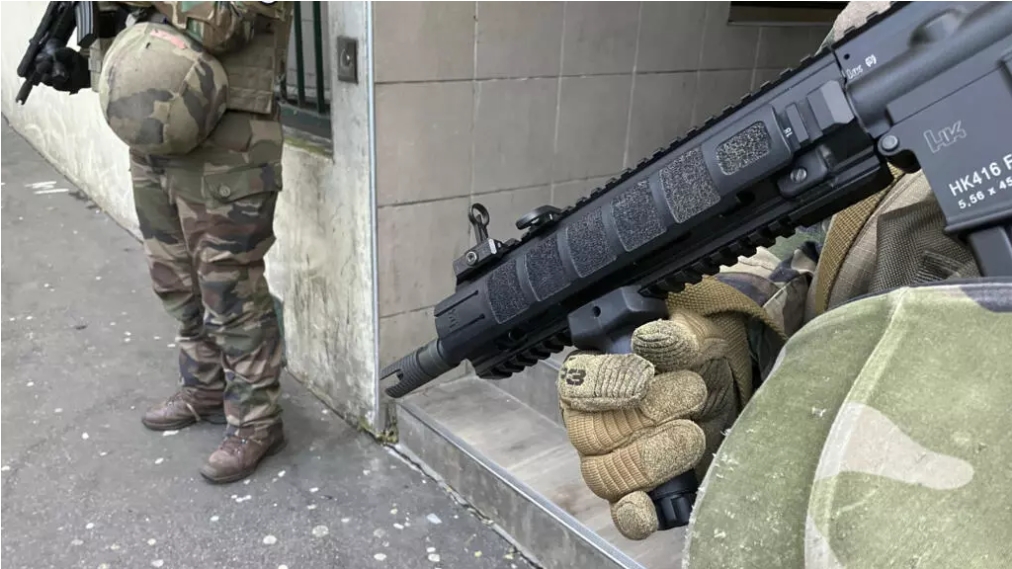
Across Europe, authorities have raised the level of alert for the risk of terrorism since the beginning of the war waged by the United States and Israel against Iran. While no action has yet been identified, the continent is used to the pressure exerted by the regime in Tehran.
Since the start of the strikes against Iran, several European countries have raised their alert level for fear of Tehran-linked actions. As soon as the first Israeli-American bombings took place on Saturday 28 February, the French authorities reinforced security measures on the territory. Interior Minister Laurent Nuñez has ordered increased protection for Israeli, American and Iranian diplomatic representations as well as Jewish places of worship.
The police have been placed on vigilance in order to "detect any action likely to disturb public order". The Sentinelle military system has also been reinforced, with particular attention paid to personalities and associations opposed to the Iranian regime present in France. The Vigipirate plan is at its highest level "attack emergency" in two years.
A concern shared by other European countries. "The Iranian regime has repeatedly demonstrated in the past that it carries out terrorist actions beyond its own borders," Marc Henrichmann, chairman of the German parliamentary committee responsible for monitoring the secret services, told the Süddeutsche Zeitung newspaper. "Retaliatory measures, including by Iranian sleeper cells in Europe, cannot be ruled out," he added, adding that protection measures must be adapted if necessary.
From Tehran, Foreign Ministry spokesman Esmail Baghaei himself warned the Europeans: "Any action against Iran would be considered a gesture of complicity with the aggressors," he said on 3 March.
« We are no longer in the configuration of the waves of attacks of the 1980s »
On Thursday 5 March, the sixth day of the war, LaurentNuññezsaid that "to date, there had been no foiled attack plan, no known, identified threat", but "vigilance is at the highest level", confirmed the Minister of the Interior.
The intelligence services fear above all targeted actions or attempts at destabilization, with potential targets of opponents of the Iranian regime as well as Israeli interests or those linked to the Jewish community.
« We are no longer in the configuration of the waves of attacks of the 1980s ", says David Rigoulet-Roze, a specialist in the Middle East, a researcher at the French Institute for Strategic Analysis (IFAS) and an associate researcher at Iris. Between 1985 and 1986, France was the target of fourteen bomb attacks in ten months, which killed fourteen people and injured nearly 300.
Before the National Assembly in 2023, the director of the DGSI Nicolas Lerner nevertheless recalled that "Iran's ability to carry the threat beyond its borders is proven", also referring to the foiled attempted attack in 2018 against an opposition rally in Villepinte, involving an Iranian diplomat posted at the Austrian embassy.
« If we look at the behavior of the Islamic Republic since its creation in 1979, we see that there have been different strategies of repression or terror used. The hostage-taking of American diplomats for 444 days is a striking example of this, and this strategy of pressure continues to this day," says Iranian-born sociologist Firouzeh Nahavandi, professor emeritus at the Free University of Brussels, recalling the fate of the Frenchmen Cécile Kohler and Gilles Paris, released last November but still banned from leaving Iranian territory.
The diaspora, a privileged target
In Germany, a German-Iranian man was convicted of trying to set fire to a synagogue in 2022. According to the authorities, the project had been planned with the help of "Iranian state agencies". "This is the first time that a court in a European Union state has identified in detail the responsibility attributed to the Revolutionary Guards," classified in January as a "terrorist organization" by the European Union, said David Rigoulet-Roze.
Traditionally, opponents of the regime, dissidents and activists living abroad have been among the first targets of this pressure. Contacted by RFI, several people from the Iranian diaspora in France, placed under police protection, said they could no longer express themselves publicly.
On RTL, Mona Jafarian, founder of the association Femme Azadi, testifies to the pressure she is subjected to: "phone calls from Iran" ordering her to keep quiet, flat tires, death threats on social networks from "Hezbollah militiamen, who pose armed in their profile pictures." Pressures that, according to her, have "increased" since the January movement.
Sociologist Firouzeh Nahavandi also testifies to this: among his contacts in France, Belgium and Switzerland, many demonstrators are victims of intimidation. "They are filmed at rallies and sometimes threatened, especially women. They are often ordinary people, who are not at the head of political organizations but who demonstrate against the regime, regardless of their persuasion. »
Indirect strategy and shadow networks
The Iranian threat in Europe also takes the form of a hybrid strategy: cyberattacks, intimidation, infiltration of dissident networks, agents of influence active in associations or during demonstrations. Some of these operations are attributed to Unit 840 of the Al-Quds Force, the external branch of the Revolutionary Guards in charge of clandestine operations abroad. This unit "organizes networks abroad that can be mobilized depending on the circumstances," explains David Rigoulet-Roze.
Several recent cases in France and Europe illustrate these indirect strategies. In February, a French court sentenced an Iranian national to one year in prison for glorifying terrorism after disseminating anti-Semitic content or praising Hamas attacks.
In 2024, an Iranian national suspected of being linked to the Revolutionary Guards' Quds Force was also arrested in Dijon and then deported to Tehran. A former executive of the Iranian public broadcaster, Bashir Biazar was considered by the French authorities as an "agent of influence" responsible for monitoring opponents of the regime and Jewish or Israeli targets in France.
Intermediaries linked to organized crime
Another method documented by several European services is the use of intermediaries linked to local criminals, which make attribution more difficult and easier to deny. Iranian networks "can mobilise third parties, sometimes people who are unclaimed or from organised crime, in order to avoid tracing directly to the source", confirms David Rigoulet-Roze. In France in particular, intelligence services suspect links between a series of fires committed in 2023-2024 by drug-related criminals against Israeli-owned companies and the Republic of Iran.
According to a DGSI report sent to the National Anti-Terrorism Prosecutor's Office in 2024 and cited by Mediapart, the use of "proxies" from the world of organized crime is a characteristic method of Iranian state terrorism.
A Tunisian national living in France, a repeat offender, is to be tried in the Netherlands for attempting to assassinate Alejo Vidal-Quadras, former vice-president of the European Parliament and supporter of the Iranian opposition, in November 2023. He was planning another attack in 2024 targeting an opponent on Dutch soil. According to several European services, the attack was ordered by Tehran.
The Swedish security services also mentioned in 2024 the involvement of criminal gangs in operations ordered by Tehran.
In July 2025, in a joint statement, Albania, Austria, Belgium, Canada, the Czech Republic, Denmark, Finland, France, Germany, the Netherlands, Spain, Sweden, the United Kingdom, and the United States condemned "the growing number of state threats from Iranian intelligence services" aimed at "killing, kidnapping, and harassing people."
The risk of self-engagement
The current context may also raise fears of another risk, says Firouzeh Nahavandi. "There can also be individuals who commit themselves to a cause and decide to avenge what is happening elsewhere. People who project themselves into war and take action without being directly guided by Iran. In the United States, just after the launch of the Israeli-American strikes on Iran, a man who had expressed "pro-Iranian regime opinions" on social networks killed two people and wounded a dozen others in a shooting attack in Texas.
While the fears are real, no retaliatory action has yet been observed in Europe. "There is no identified clear threat," insists David Rigoulet-Roze. But the combination of the geopolitical context and the existing networks of influence justifies, according to him, "increased vigilance".
Questioned on the subject during his hearing in the Senate on 4 March, Pierre Razoux, academic director of the Mediterranean Foundation for Strategic Studies in the Senate on Wednesday 4 March, replied: "Can Europe be a target? Yes, of course, it has already been. During the Iran-Iraq war, it was heavily so. That being said, I don't think we're a priority target. There are many other targets if you want to "annoy" the United States. But yes, the risk exists, that's for sure." (RFI, 2026-03-09)